Regenerative Immunology
Breathe Biologics is investigating how the JadiCell™ platform may influence dysregulated inflammatory responses while supporting endogenous repair processes in severe pulmonary disease.
Restoring Immune Homeostasis Through Investigational Cellular Therapy
Regenerative immunology is an emerging field that examines how cellular therapies may influence dysregulated immune responses while supporting endogenous tissue repair and restoration of organ function.
Unlike therapies designed to broadly suppress inflammation, regenerative immunology seeks to promote the resolution of inflammation and facilitate recovery of damaged tissue through coordinated interactions with immune, vascular, and parenchymal cells.
JadiCell™ is an investigational allogeneic mesenchymal cell platform derived from the subepithelial layer of umbilical cord tissue. The platform is being evaluated for diseases characterized by immune dysregulation, endothelial injury, epithelial damage, and aberrant tissue remodeling.
Published preclinical and clinical MSC studies, including the randomized placebo-controlled JadiCell study in COVID-19-associated ARDS, suggest potential effects on inflammatory cytokine profiles and biomarkers associated with immune regulation.
MSC-derived paracrine signaling has been shown experimentally to influence multiple components of innate and adaptive immunity through cytokines, growth factors, extracellular vesicles, and regulatory signaling molecules.
Future studies will evaluate whether modulation of immune homeostasis contributes to clinical outcomes across multiple pulmonary diseases.
A Multi-Pathway Regenerative Immunology Platform
JadiCell™ is being investigated for biological activity mediated primarily through paracrine signaling, immunomodulatory pathways, regenerative mediators, and cellular communication within the injured pulmonary microenvironment.
Proposed Biological Activities of JadiCell™
The precise mechanism of action of JadiCell has not been fully established. Current understanding is based on published MSC biology, translational studies, biomarker analyses, and exploratory clinical observations.
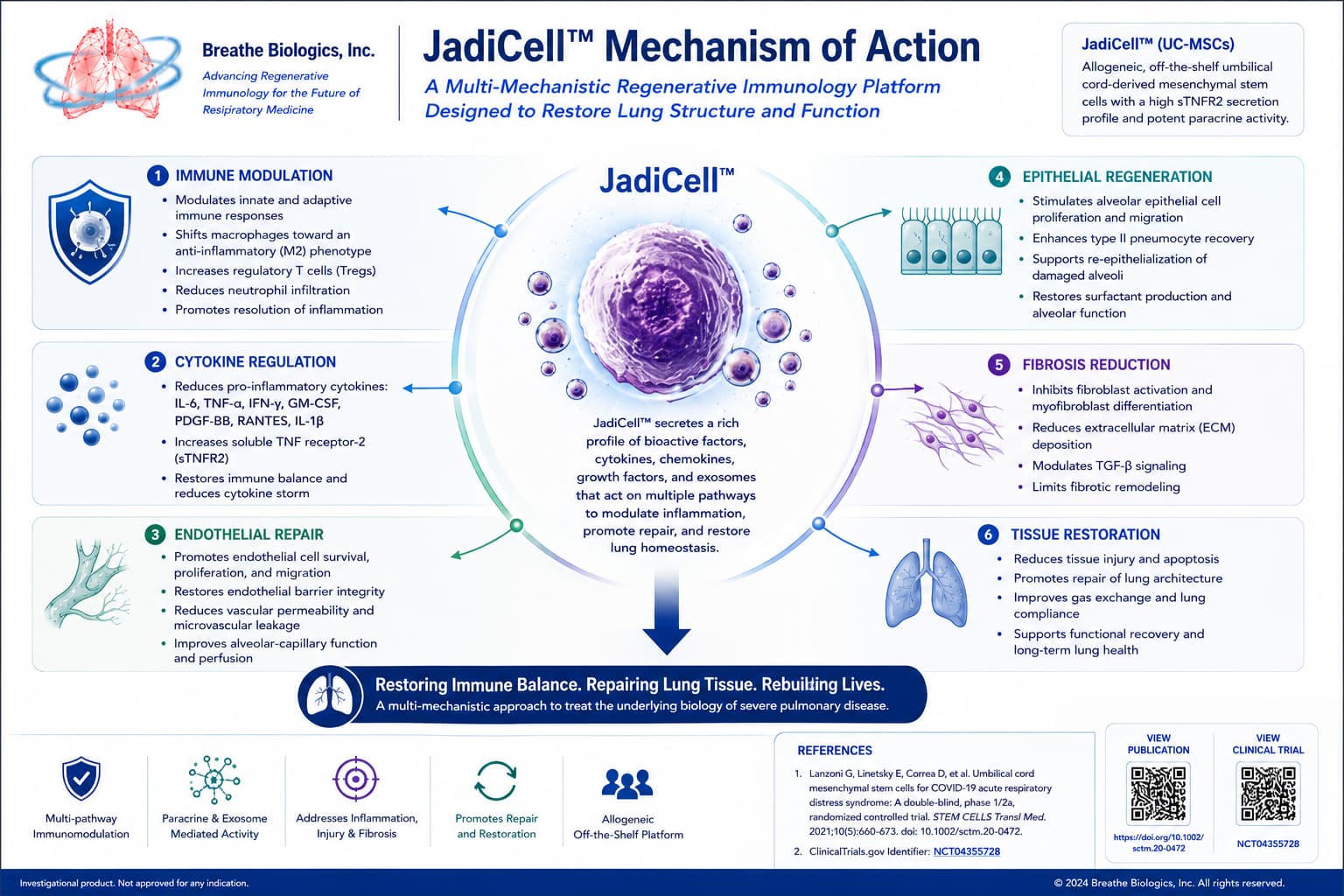
Immune Modulation
Investigation of innate and adaptive immune responses.
Cytokine Regulation
Potential modulation of inflammatory cytokine cascades.
Endothelial Stabilization
Potential support of vascular barrier integrity.
Epithelial Repair
Investigation of alveolar epithelial recovery processes.
Fluid Clearance
Potential support of alveolar fluid-clearance mechanisms.
Tissue Remodeling
Investigation of repair and fibrosis-associated pathways.
The randomized placebo-controlled clinical study demonstrated changes in circulating inflammatory biomarkers together with favorable exploratory clinical observations in COVID-19-associated ARDS.
MSCs appear to influence multiple cellular pathways simultaneously rather than functioning through a single molecular target.
Current investigation is evaluating whether coordinated regulation of these pathways may contribute to recovery from severe inflammatory lung injury.
Regulation of Dysregulated Inflammatory Responses
Acute and chronic pulmonary diseases frequently involve dysregulated innate and adaptive immune responses characterized by excessive cytokine production, persistent leukocyte activation, and impaired resolution of inflammation.
MSC therapies have demonstrated immunomodulatory properties in experimental systems and continue to be investigated in clinical studies.
- Macrophage phenotype
- T-cell activation
- Dendritic-cell maturation
- Neutrophil trafficking
- Regulatory T-cell activity
- Cytokine production
The published JadiCell clinical study reported reductions in multiple inflammatory cytokines including TNF-α, TNF-β, IFN-γ, GM-CSF, PDGF-BB, and RANTES during early follow-up. Increased soluble TNF receptor 2 was also observed.
Experimental research suggests these interactions may occur primarily through secreted signaling molecules and extracellular vesicles.
Further investigation will determine whether modulation of immune-cell signaling contributes to clinical recovery in pulmonary inflammatory diseases.
Supporting the Pulmonary Microvasculature
Endothelial injury contributes to increased vascular permeability, pulmonary edema, and impaired gas exchange in many forms of acute lung injury.
Maintenance of endothelial barrier integrity represents an important therapeutic objective in inflammatory pulmonary disease.
- Support endothelial-cell survival
- Reduce vascular permeability
- Stabilize intercellular junctions
- Promote angiogenic signaling
- Reduce inflammatory endothelial activation
Published MSC studies have demonstrated experimental improvements in endothelial permeability and vascular integrity in preclinical models. The JadiCell clinical trial did not directly measure endothelial repair.
MSC-derived factors may influence endothelial survival, permeability, junction stability, angiogenic signaling, and inflammatory activation.
Future studies may characterize endothelial biomarkers and vascular endpoints to better understand potential effects on pulmonary microvascular repair.
Supporting Restoration of the Alveolar Epithelium
Alveolar epithelial injury is a defining feature of ARDS and contributes to impaired barrier function, fluid accumulation, and loss of gas exchange.
Type II alveolar epithelial cells play essential roles in surfactant production and epithelial regeneration.
- Promote epithelial-cell survival
- Reduce apoptosis
- Enhance epithelial proliferation
- Support alveolar barrier restoration
- Improve fluid transport
Experimental MSC studies have demonstrated improved epithelial wound healing and preservation of alveolar barrier integrity in multiple animal models. Direct clinical evidence of JadiCell-mediated epithelial regeneration has not yet been established.
MSC-derived secreted factors have been reported experimentally to influence epithelial survival, proliferation, barrier restoration, and fluid transport.
Additional translational studies may clarify whether these biological activities contribute to recovery in inflammatory lung diseases.
Regulation of Tissue Repair and Fibrosis
Following severe lung injury, persistent inflammation may result in abnormal extracellular matrix deposition, fibroblast activation, and progressive fibrosis.
Regulation of tissue remodeling represents an important area of regenerative medicine research.
- Regulation of fibroblast activation
- Modulation of TGF-β signaling
- Reduction of myofibroblast differentiation
- Regulation of extracellular matrix turnover
- Promotion of physiologic tissue repair
Experimental MSC studies have demonstrated reduced collagen deposition and modulation of profibrotic signaling pathways in animal models. Clinical evidence demonstrating antifibrotic effects of JadiCell has not been established.
Potential biological activity may involve fibroblast activation, TGF-β signaling, myofibroblast differentiation, and extracellular matrix turnover.
The potential role of JadiCell in progressive pulmonary fibrosis remains investigational and requires appropriately designed clinical studies.
Translational Biomarkers Supporting Biological Investigation
Biomarkers provide important insights into pharmacodynamic activity and may improve understanding of biological mechanisms during clinical development. Exploratory biomarker analyses from the published JadiCell clinical study evaluated multiple inflammatory mediators associated with severe pulmonary inflammation.
sTNFR2
Inflammatory Mediators
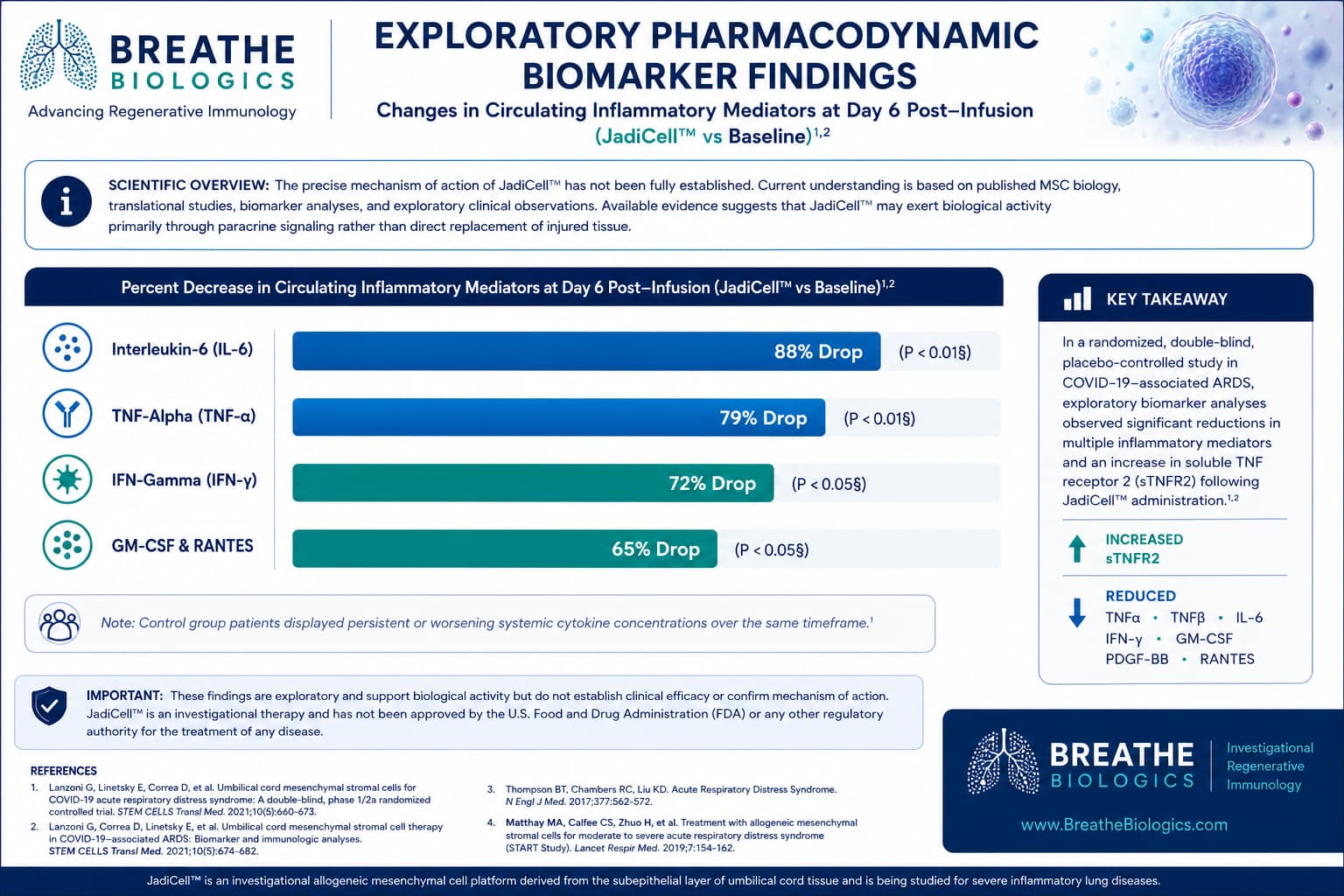
Exploratory analyses reported increased soluble TNF receptor 2 and reductions in several inflammatory mediators after JadiCell administration.
These biomarkers represent pathways associated with TNF signaling, cytokine regulation, immune activation, endothelial injury, leukocyte recruitment, and inflammatory resolution.
Future studies may evaluate biomarker-guided patient stratification, pharmacodynamic response monitoring, and relationships between biomarker modulation and clinical outcomes.
Medical Affairs Disclaimer: JadiCell™ is an investigational cellular therapy and has not been approved by the U.S. Food and Drug Administration or other regulatory authorities for the treatment of any disease. Statements regarding biological mechanisms, regenerative effects, or potential therapeutic applications are based on published scientific literature, translational research, and investigational clinical findings where indicated. Mechanistic rationale should not be interpreted as evidence of clinical efficacy.
Selected References
- Lanzoni G, et al. STEM CELLS Translational Medicine. 2021;10(5):660–673.
- Thompson BT, Chambers RC, Liu KD. Acute Respiratory Distress Syndrome. N Engl J Med. 2017;377:562–572.
- Matthay MA, et al. Mesenchymal Stromal Cells for Acute Respiratory Distress Syndrome. Lancet Respir Med. 2019.
- Caplan AI. Mesenchymal Stem Cells: Time to Change the Name! Stem Cells Transl Med. 2017.
- Pittenger MF, et al. Mesenchymal Stem Cell Perspective. NPJ Regen Med. 2019.